Children’s Cavities in Kerobokan: Fill or Extract a Baby Tooth?
A decayed baby tooth may be filled when it remains suitable for restoration. Extraction is considered when damage, infection, or developmental factors make retaining it inappropriate. For children’s cavity treatment in Kerobokan, the decision starts with an examination rather than the assumption that every baby tooth will fall out soon. Floss lists children’s fillings at […]
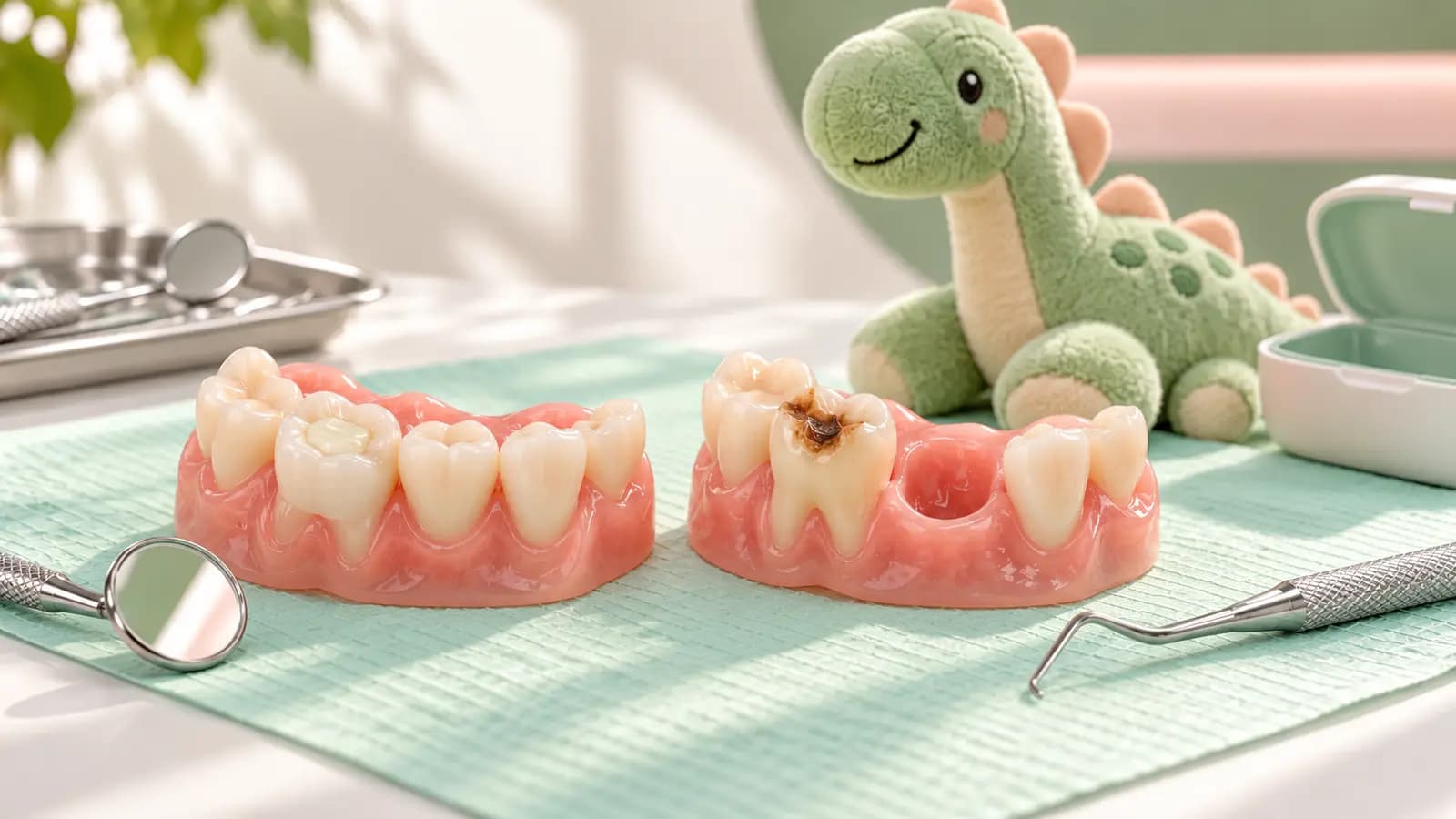
A decayed baby tooth may be filled when it remains suitable for restoration. Extraction is considered when damage, infection, or developmental factors make retaining it inappropriate. For children’s cavity treatment in Kerobokan, the decision starts with an examination rather than the assumption that every baby tooth will fall out soon.
Floss lists children’s fillings at Rp400,000–Rp550,000, with an estimated duration of 30–45 minutes, and children’s extractions at Rp350,000–Rp460,000, taking approximately 15–30 minutes. The final plan depends on the tooth, any supporting treatment, and your child’s needs.
Why baby teeth still matter
Baby teeth support chewing and function throughout a child’s development. A painful tooth can affect eating, sleep, and confidence about dental visits. Untreated infection can also affect surrounding tissues.
Some baby teeth are needed for several more years before replacement. Early loss may require an assessment of space for the permanent tooth. Expected replacement timing is therefore considered alongside the severity of damage.
What determines whether to fill or extract?
The dentist assesses the depth of decay, remaining sound tooth structure, pulp involvement, and signs of infection. X-rays may help reveal damage that is not directly visible and assess permanent-tooth development.
A tooth without pain is not necessarily safe to leave untreated. Equally, previous pain does not automatically mean extraction. Pulp health and restorability determine whether a filling is enough, pulp treatment is needed, or removal is more appropriate.
Options the dentist may discuss
| Option | Clinical consideration | Floss estimate |
|---|---|---|
| Children’s filling | Damage that can still be restored | Rp400,000–Rp550,000; 30–45 minutes |
| Children’s root canal treatment | Selected teeth with pulp involvement that can be retained | Rp1,250,000–Rp2,250,000; 30–60 minutes |
| Baby-tooth extraction | A tooth unsuitable for retention or with another indication | Rp350,000–Rp460,000; 15–30 minutes |
| Space maintainer when indicated | Assessment after early baby-tooth loss | From Rp1,500,000; two visits |
A paediatric crown may also be considered when a tooth requires more extensive coverage. Discuss materials and treatment availability during the consultation. A space maintainer is not necessary after every extraction.
When your child needs prompt care
Seek an early review for swelling, pus, spontaneous pain, or pain that interferes with sleep and eating. Fever or facial swelling warrants urgent assessment. Breathing difficulty, swallowing problems, or rapidly worsening illness requires emergency medical care.
Do not rely on leftover antibiotics for a cavity. Medication does not repair damaged tooth structure. The dentist needs to identify the source and establish which treatment is needed to control infection.
Help your child prepare for the appointment
- Explain in simple terms that the dentist will look at the tooth and help it.
- Share the pain history, previous experiences, allergies, and medicines.
- Ask whether care can be staged and how comfort will be managed.
- Avoid promising that there will be no sensation at all. Let the dentist explain the planned steps.
The approach depends on age, cooperation, and the amount of treatment. Particular care needs or referral options can be discussed when necessary. Completing everything in a single visit is not the only measure of successful care.
After a filling or extraction
Follow the eating and cleaning instructions for the procedure performed. After local anaesthetic, supervise your child to prevent biting a numb lip or cheek. Contact the clinic for an uneven bite after a filling, worsening pain, or extraction bleeding that is difficult to stop.
Treating one tooth should be accompanied by an assessment of the others. A filling repairs existing damage, while the habits that contributed to decay also need attention to reduce new cavities.
Daily steps to reduce further decay
- Help your child brush twice daily with an age-appropriate amount of fluoride toothpaste.
- Clean between touching teeth with adult assistance.
- Reduce frequent sugary snacks and sugary drinks before bed.
- Discuss fluoride, sealants, and a review schedule based on your child’s cavity risk.
Bring an example of a typical day’s eating and drinking to the appointment. A specific change, such as stopping prolonged sipping of a sweet drink throughout the afternoon, may be easier to maintain than a broad instruction to avoid all sugar.
Before the visit ends, ask which teeth need treatment first and what can be monitored. An agreed order helps parents understand the plan when several teeth are affected, especially if appointments need to be spread out.
Choose treatment for the condition of each tooth
Arrange an examination before decay becomes deeper or painful. Plan dental care with a dentist Bali families can consult at Floss Dental to assess fillings, pulp treatment, or extraction for an affected baby tooth.
FAQ About Cavities in Children
How much does a baby-tooth filling cost?
Floss lists children’s fillings at Rp400,000–Rp550,000. The overall estimate follows assessment, particularly if imaging or pulp treatment is needed.
When should a baby tooth be extracted?
Extraction requires a clinical indication, such as a tooth that cannot be restored or an infection unsuitable for treatment while retaining it. Replacement timing and permanent-tooth development are also considered.
Can a child’s cavity become serious?
Untreated decay can progress to pain and infection. An examination before symptoms develop allows treatment options to be considered before more damage occurs.